
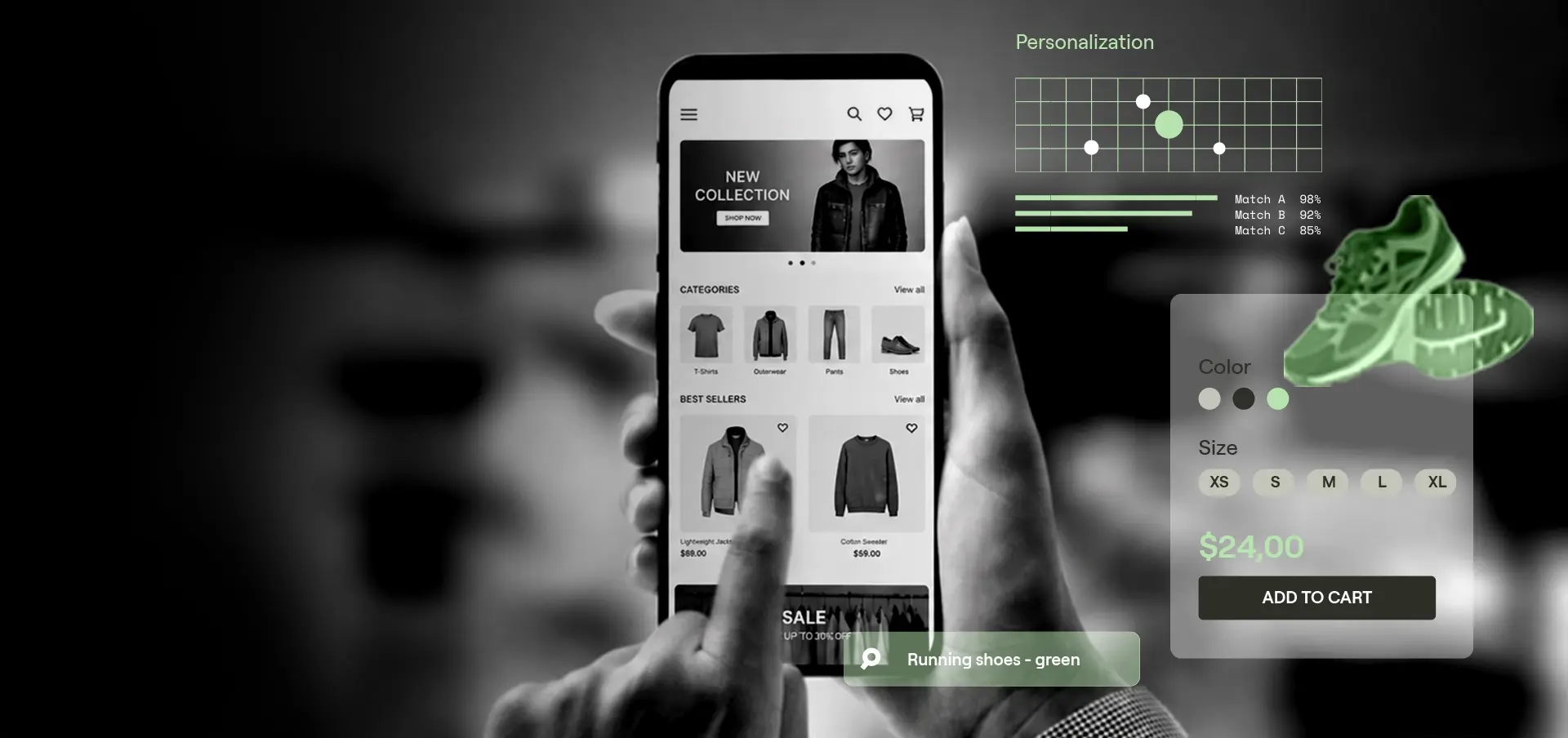
New research from Kearney highlights how information overload is changing consumer expectations and why AI-powered product discovery is becoming a critical competitive differentiator.
Retailers have spent decades expanding choice. Bigger catalogs, more brands and more ways to shop have created unprecedented convenience. But more choice doesn’t necessarily make shopping easier.
In its new report, The Tyranny of Too Much: The Future Consumer, Kearney draws on research involving more than 21,500 consumers across 20 countries to explore how information overload is changing consumer expectations.
For retailers, the implication is clear: competitive advantage increasingly depends not simply on the products they offer, but on how effectively they help customers discover what matters to them. And that’s where AI-powered product discovery becomes particularly important.
When more choice becomes a competitive disadvantage
Expanding assortment increases the likelihood that a retailer has something a customer wants. But availability is only half the equation. Customers still need to find the right product.
Consider Kleinanzeigen, Germany’s largest re-commerce marketplace, with more than 32 million monthly users and 58 million listings. For a business operating at this scale, the challenge isn’t simply giving shoppers access to more products. It’s helping them discover the products most relevant to their interests.
As Albert Górski, Head of Engineering, Core Experience at Kleinanzeigen, puts it: “The future of the resale market will be defined not by the size of a platform’s inventory, but by the intelligence of its platform.”
That’s why Kleinanzeigen uses Vespa.ai to bring together search, recommendations, and real-time personalization, helping customers discover relevant listings from an enormous and constantly changing inventory. Kearney’s research reinforces this shift. Retailers that simply present more options risk adding to information overload. The opportunity is to replace that overload with relevance through a smarter approach to search and discovery.
From personalization to genuine understanding
Kearney makes an interesting distinction between personalized and personal. Traditional personalization often relies on previous purchases, customer segments, or products frequently bought together. These approaches have value, but they don’t necessarily capture what a customer wants right now.
A returning shopper might be buying for someone else, exploring an unfamiliar category, or responding to a new trend. Truly relevant discovery needs to combine multiple signals: current intent, behavior, preferences, product attributes, availability, and the context of the interaction.
This is where the underlying technology matters. The Vespa AI Search Platform combines text, vector, and structured retrieval with advanced ranking and real-time data in a single platform. Retailers can bring these signals together to determine relevance and continuously improve how products are discovered and recommended.
The result is a more relevant shopping experience built around the retailer’s own products, customers and data. Unlike generic AI capabilities available to everyone, that proprietary information creates an opportunity for genuine competitive differentiation.
The business case for relevance
Kearney identifies another important shift: consumers increasingly judge brands by the outcomes they deliver rather than brand familiarity alone. In its survey, 86% said they care more about whether something works than the brand name attached to it.
For retailers, the commercial questions are straightforward. Did the customer find what they wanted? Was the recommendation useful? Did the experience make purchasing easier?
We’ve seen the relationship between relevance and business outcomes firsthand. Vinted, one of Europe’s leading secondhand marketplaces, replaced Elasticsearch with Vespa.ai to support product discovery across approximately one billion items.
The migration enabled more sophisticated ranking, faster search, and more responsive indexing of changing inventory. The business results included a 1.1% increase in transactions and a 0.6% increase in gross merchandise value, representing more than €3.5 million in uplift. This illustrates why product discovery deserves attention beyond the engineering team. Improvements in relevance can translate directly into measurable commercial results.
AI shopping assistants raise the stakes
Kearney also explores AI’s growing role in shopping decisions. Its research suggests consumers are more comfortable with AI recommending products than making purchases autonomously. For example, in grocery shopping and meal planning, 26% would let technology suggest options, but only 7% would let it decide and purchase.
The immediate opportunity may therefore be less about replacing shoppers with autonomous agents and more about helping them make better decisions.
Imagine a customer asking an AI shopping assistant:
“I need a lightweight waterproof jacket for hiking in Scotland, under £150, that will arrive before Friday.”
Answering that question requires more than a convincing conversational response. The application must understand the request, identify relevant products, evaluate their attributes, check current inventory and delivery information, and rank the available choices.
In conversations with retailers, I hear a consistent message: before they can move forward with AI shopping assistants and agents, they need to get the foundations of product discovery right. That means understanding intent, combining multiple signals, and delivering relevant results from constantly changing product information.
AI agents don’t replace sophisticated product discovery. They make it even more important.
Vespa.ai provides the retrieval, ranking, and real-time serving capabilities to support these experiences, whether through traditional search, personalized recommendations or AI-powered shopping assistants.
Your data is your competitive advantage
As AI becomes more widely available, retailers face an interesting challenge. The foundation models and tools powering AI applications are increasingly accessible to everyone. But every retailer has something different: its products, customers, inventory, behavioral data, and accumulated understanding of how people shop.
Increasingly, this will also mean using smaller, specialized AI models tailored to particular industries, applications or individual retailers. These can be cheaper to run and more relevant to a merchant’s specific needs than relying exclusively on large, general-purpose models. Vespa.ai is already helping customers put these models into production, combining specialized models with proprietary data to improve search, ranking and recommendations.
The competitive opportunity lies in putting that proprietary information to work. Retailers need to connect their data to AI applications in ways that are accurate, relevant, responsive and scalable. The Vespa AI Search Platform gives organizations control over how information is retrieved and ranked, enabling differentiated experiences rather than relying entirely on generic, off-the-shelf capabilities.
Kearney’s research points to a future in which successful brands focus less on increasing choice and engagement and more on understanding customers, reducing effort, and delivering outcomes that earn trust. For retailers, that makes product discovery much more than a website feature. It becomes a competitive capability influencing customer experience, conversion, loyalty, and growth.
The winners won’t necessarily be the retailers offering the most choice. They’ll be the ones making it easiest for customers to find the right choice.
Read Kearney’s report, The Tyranny of Too Much: The Future Consumer, for its broader analysis of how consumer expectations are changing.