Photo by National Cancer Institute on Unsplash
The future of GenAI in pharma and healthcare isn’t about building bigger models — it’s about smarter retrieval.
By Harini Gopalakrishnan, Head of GTM, Vespa.ai
Originally presented at the Fierce Pharma Webinar: “You Have the Model, Now What? Lessons on Making AI Work in Life Sciences and Breaking the Chatbot Mirage.” This is a five part quick read series that summarizes the panel discussion highlighting key topics of the conversations..
→ Full video: fierce-pharma-webinar
Pharma Commercial: Scaling AI Without Losing Trust
“Commercial data is built for human stories, not machine precision. AI must learn to tell those stories back.”
The focus now shifts to the other end of lifesciences, namely Commercial & Marketing.
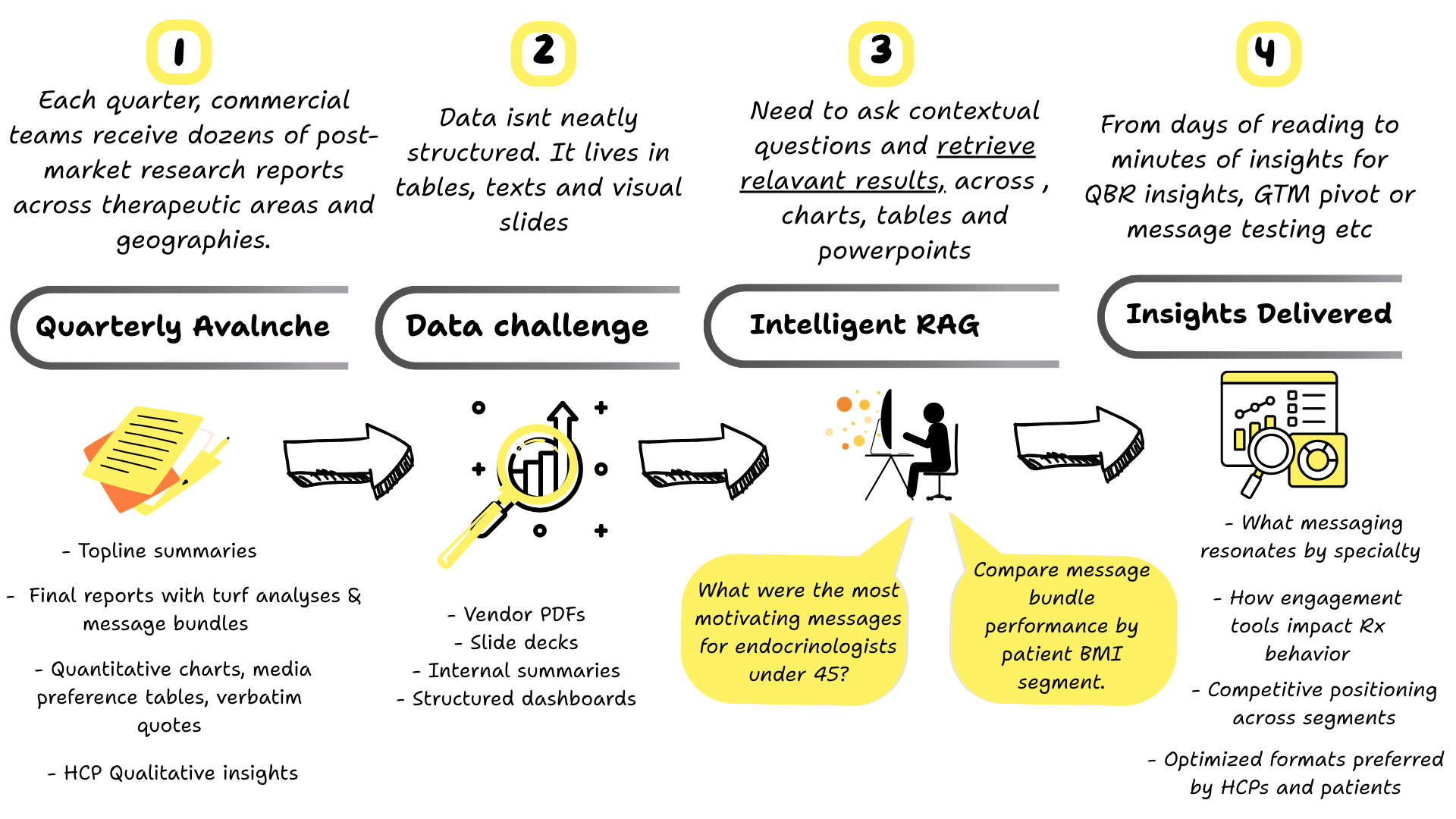
The data is not multi-modal like R&D but is multifarious in terms of the avalanche of brand documents they deal with.
The question therefore was about understanding where in this workflow do the concepts like “Personalization” and “Relevancy” make sense?
Anubhav Srivastava, AI Engineering Head for Commercial at Novo Nordisk, reframed commercial AI as a human-centric search task.
Field reps and medical liaisons don’t need “another chatbot” — they need fast, relevant retrieval from millions of documents. Organizations are increasingly using Retrieval-Augmented Generation (RAG) based AI to manage their vast corpus of unstructured documents. This approach aims to provide different commercial personas with accurate, fast, and relevant information extracted from millions of documents. While initial, quick AI solutions may appear promising, performance becomes a significant challenge as they scale, particularly when dealing with complex data-rich documents like dossiers that contain charts, graphs, and embedded images. This is where the focus on performance becomes critical.
He identified three Ps: Perception, People, and Performance. The biggest challenge isn’t building prototypes — it’s maintaining performance and trust at scale. And with the inspiration from search-first companies like Spotify and Perplexity, we need the fourth P for Personalization to this mix. The information retrieved varies depending on whether it is an HCP, an HCO or someone looking for brand summary in pre-call. These user specific traits are the implicit signals that help with personalization.
Key Takeaways
-
Retrieval must adapt to personas — scientists, reps, payers — each with unique context.
-
Manage perceptions of AI capabilities; set realistic expectations.
-
Design for sustained performance, not short-term flash.