
Last week we were impacted by a slew of critical and high severity vulnerability disclosures (CVE’s) in our dependencies, remote code execution as root by sending base64 to a Java server, and in Nginx and the Linux kernel over HTTP/2 (CVE-2026-114938, -123007, -123634, -123633, -121810, -113425, -99288). We had protections or patches deployed across all the Vespa applications we run, over 180k cores, in less than nine hours. No downtime on queries or writes were necessary. How about you, did you get all your patches out for all the CVEs that affect your stack last week?
The security race
When a new CVE is disclosed a race is starting. Will you manage to obtain patched versions of all your dependencies and roll them out fully in production before they are used in attacks? We used to be able to win this race at a leisurely pace; creating working exploits from vulnerabilities is usually hard. Attackers would have to understand the CVE, do their research on how to use them in an attack that works in the wild, then find real-world targets to execute the attacks. This took weeks at best. However, with AI all of this is automated: AI agents scan the CVE database, work out attacks, and execute them autonomously. To keep winning the race we need to go much faster.
We also need to do it more. Each time there is a new CVE, a new race is starting, and of course, AI doesn’t just help attackers go faster, it also lets us find vulnerabilities faster.
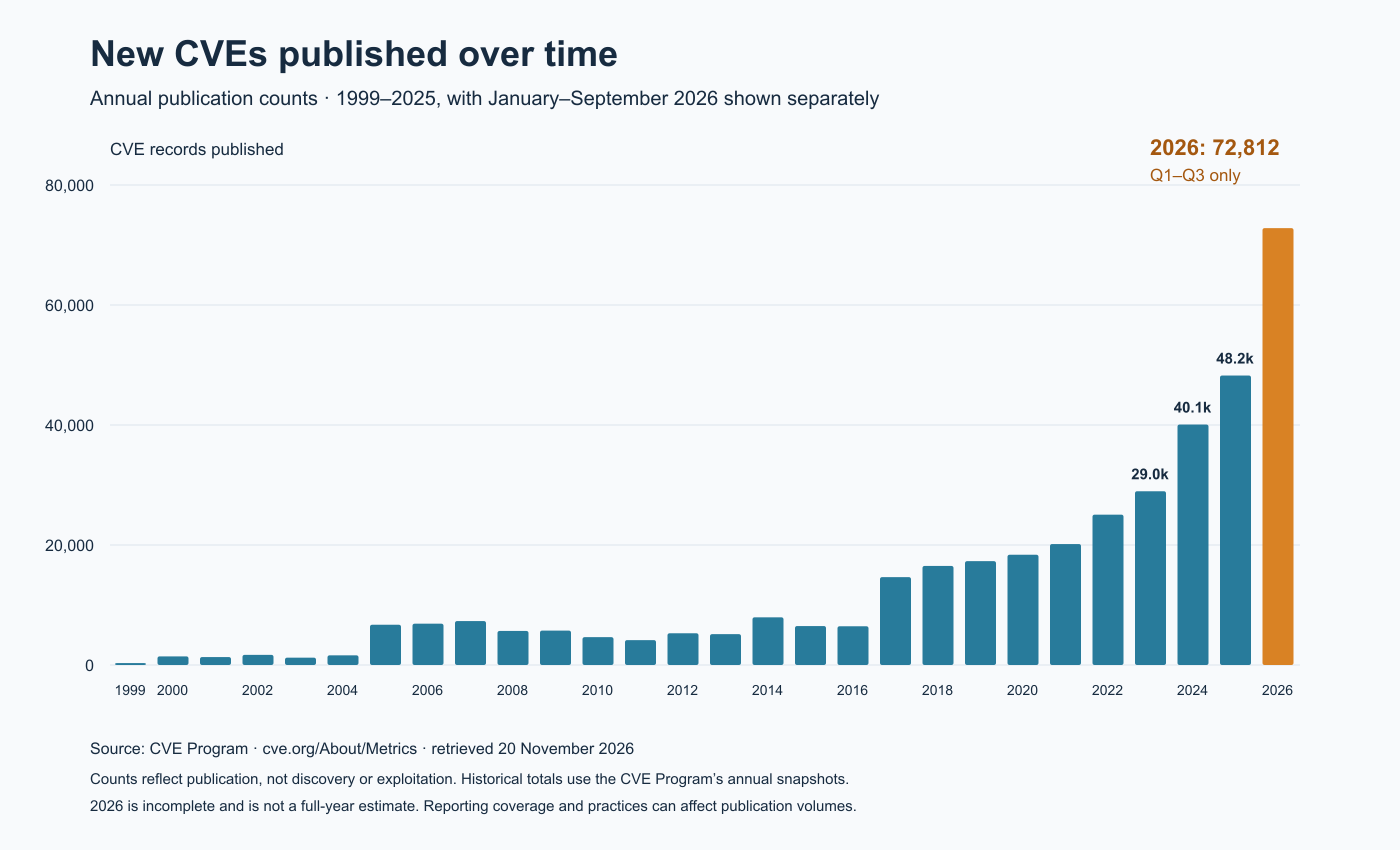
CVEs found are rapidly increasing.
If applying protections to a new CVE require manual work, you have probably already failed to keep up.
What must be done?
We can keep winning the race in the era of AI-driven threats. Fundamentally, more efficient discovery favors defence. But we cannot do it by continuing our old ways. Organizations that have internalized today’s threat environment work to:
- Ensure their dependencies deliver patched versions with guaranteed minimal delay and that these are applied in builds as soon as they become available. This often requires buying commercial distributions, even if the software itself is composed of open source.
- Ensure patches of every component software component down to the OS is rolled out in production as soon as is possible without impacting production traffic. Cloud service vendors need to guarantee this, and for software you host yourself, this can be substantial development projects.
- Apply AI to find vulnerabilities autonomously and continuously in all in-house developed software.
None of this is easy, but business as usual is not an option if you need to protect your data, customers and services. The world is changing faster than we are used to, and the main challenge now isn’t that we don’t know what to do, but to get everybody to take the situation seriously enough, fast enough.
